
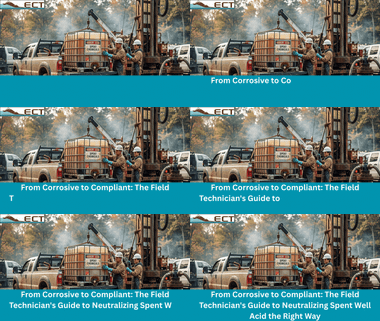
How to Neutralize Spent Well Acid in the Field
Posted by Walford Guillaume on Sep 16th 2026
From Corrosive to Compliant: The Field Technician's Guide to Neutralizing Spent Well Acid the Right Way
Picture this: A crisp September breeze is creeping in, taking the heat off a grueling pumping season just as your crew pulls a heavy tote of spent descaling acid from the depths of a suffocating well casing. The downhole work is done. The scale is gone. The well is flowing clean again. But there's still a five-gallon problem sitting on the truck bed — a tote of low-pH liquid that cannot simply be tipped into the gravel lot, the storm drain, or the nearest patch of grass.
This is the moment where a lot of otherwise excellent well rehabilitation jobs go sideways. Technicians who nail the downhole chemistry sometimes treat surface neutralization as an afterthought. That's a mistake — and, depending on your local discharge regulations, potentially a costly one. Consequently, understanding how to neutralize spent acid at the surface isn't a "nice to have" skill for environmental technicians, drillers, and well operators. It's a core competency, every bit as essential as knowing your descaler dosages.
Below, we'll walk through exactly how to neutralize spent acid from a well casing before disposal, why post-treatment neutralization matters, the chemistry behind it, and a step-by-step field protocol you can put to use on your very next job.
Why Late-Summer Well Maintenance Puts Neutralization Front and Center
As irrigation, agricultural, and municipal pumping demands taper off toward September, many well owners finally give their systems a breather — which makes late August and early fall prime time for post-season well maintenance. Products like Nu-Well 100 Pelletized and Nu-Well 110 Granular are the workhorses of this window, dissolving carbonate scale and biofouling that built up over a hard summer of pumping.
But here's the part that's easy to overlook: once that dwell period ends, you're left holding a batch of spent acid with a rock-bottom pH. And discharging that acid untreated isn't just an environmental risk — it's a code violation waiting to happen. Corrosive runoff can damage septic infrastructure, kill surrounding vegetation, and, in many jurisdictions, trigger reportable discharge incidents. In other words, the job isn't actually finished until the surface waste is handled as carefully as the well itself.
The Chemistry: Why Nu-Well 600 Beats Straight Caustic Soda
For decades, some crews defaulted to plain sodium hydroxide (caustic soda) to neutralize spent acid in the field. It works, technically — but it comes with real drawbacks. Straight caustic soda reacts violently, generating sudden heat spikes and, in some formulations, harsh vapors that put technicians at unnecessary risk, particularly in enclosed or poorly ventilated wellhead areas.
That's precisely the gap Nu-Well 600 pH Neutralizing Agent was engineered to close. As a food-grade, powdered alkali base purpose-built for field neutralization, it offers three distinct advantages over generic caustic treatments:
- No toxic vapors. Nu-Well 600 reacts with spent acid without releasing the harmful secondary fumes associated with raw caustic soda, making it far safer for technicians working near the wellhead.
- Clean byproducts. The neutralization reaction converts hazardous acid into water, dissolved salts, and carbon dioxide — nothing that raises red flags during a compliance inspection.
- Regulation-ready disposal. Once the treated batch settles into a neutral pH range of roughly 6.5 to 8.5, it's generally suitable for surface discharge under most local environmental guidelines (always confirm against your jurisdiction's specific rules before disposal).
In short, Nu-Well 600 doesn't just neutralize acid — it does so in a way that keeps your crew safer and your paperwork simpler.
Your Step-by-Step Field Neutralization Protocol
Before a single drop of acid moves, make sure every technician on-site is equipped with proper PPE: chemical-resistant gloves, safety goggles, and a face shield. Surface neutralization is far gentler than handling raw caustic soda, but it's still an active chemical reaction, and cutting corners on safety gear is never worth the risk.
1. Pump Spent Acid Into a Surface Holding Vessel
First things first: get that spent acid out of the well casing and into a dedicated poly tank, tote, or other temporary containment vessel. Never — under any circumstances — discharge untreated acid directly onto bare ground or into an open drainage channel. This single step is where most compliance violations originate, so treat it as non-negotiable.
2. Pre-Mix the Nu-Well 600 Solution
Next, dissolve your Nu-Well 600 powder into water within a separate mixing tank before introducing the spent acid. Why pre-mix first? Because pre-dissolving the alkaline base ensures it's distributed evenly throughout the solution, rather than clumping unevenly at the bottom of the tank — which would leave pockets of the batch under-treated.
3. Slowly Combine the Two Solutions and Watch for Effervescence
Now comes the reaction itself. Gradually blend the acidic well water into your pre-mixed Nu-Well 600 batch — slowly is the operative word here. As the acid meets the base, you'll see active bubbling, or effervescence, as carbon dioxide is released.
Field tip: Keep the treatment area well-ventilated throughout this step. Once the fizzing and bubbling subside completely, that's your visual cue that the reaction is nearing completion. However, visual cues alone are never sufficient for confirming full neutralization — which brings us to the next step.
4. Verify the Final pH — Don't Skip This
This is the step that separates a compliant job from a liability. Use a calibrated digital pH meter or wide-range pH test strips to confirm the entire holding vessel — not just the surface layer — has reached that safe 6.5–8.5 range before you even think about discharge.
If your readings still show a pH below 3.0, don't force it. Instead, slowly add an additional slurry of Nu-Well 600 and water, mixing thoroughly, and re-test. Rushing this step to save ten minutes on-site is exactly how avoidable violations happen.
Building Out a Complete Well Rehabilitation Toolkit
Neutralization is the final chapter of a much bigger story — one that starts the moment your crew identifies scale, biofouling, or chlorine residue in a well. For that reason, well-prepared field trucks typically stock the full Nu-Well chemical lineup, not just the neutralizer:
- Nu-Well 100 Pelletized Cleaner — Dense, fast-sinking pellets designed to clear stubborn carbonate scale at the bottom of small-diameter well screens.
- Nu-Well 110 Granular Descaler — A heavy-duty sulfamic acid blend featuring built-in color indicators, so technicians can visually track pH shifts throughout the treatment process.
- Nu-Well 310 Bioacid Dispersant — A polymeric-acid formulation engineered to break down biological slime mats (biofilms) while keeping dissolved iron in suspension downhole.
- Nu-Well 500 Chlor-Out — Built specifically to rapidly neutralize elevated chlorine concentrations following well shock-disinfection.
Each of these products is NSF-certified, meaning they meet recognized standards for use in drinking water applications — an important consideration for any technician working on potable wells.
The Takeaway: Finish the Job Below Ground and Above It
Here's the bottom line: proper well rehabilitation doesn't end when the descaler has done its work downhole. It ends when the surface waste has been safely, verifiably neutralized and responsibly disposed of. Skipping or rushing that final phase puts your crew, your client's property, and your company's compliance standing all at unnecessary risk.
By building Nu-Well 600 into your standard post-treatment workflow, field crews can:
- Protect technicians from the harsh vapors and heat spikes associated with raw caustic soda
- Keep surrounding vegetation, gravel lots, and storm drains free of corrosive runoff
- Move faster toward full environmental compliance with a documented, verifiable pH log
- Close out every job — from carbonate scale removal to final discharge — with total confidence
As pumping season winds down and post-season maintenance ramps up, now is the time to make sure your trucks are stocked and your crews are trained on proper neutralization protocol. A well rehabilitation job isn't truly complete until the last drop of waste has been made safe.
Ready to close out your late-summer maintenance campaign the right way? Explore ECT Manufacturing's full line of Well Maintenance Chemicals, or reach out to our technical team to help calculate your exact neutralization dosages for your next job.